Paul Gilbert SJ
The important moments and complicated history

I. 1607-2023
BRIEF HISTORY OF SAINT ROBERTO BELLARMINE COLLEGE
- 1. The complicated history of Bellarmino and its intellectual tradition
- 2. An international community
- 3. Some guidelines reported by Father Arturo Sosa
The Collegio Bellarmino was born as a seminary run by the Society of Jesus and then as a house of studies for the order itself. In this short presentation, I will recount (1) the most important moments of its centuries-old and complicated history, then I will illustrate (2) its current particularities, and finally I will recall (3) some fundamental passages from a letter from Father Arturo Sosa, SJ, Superior General of the Society, from 2019 on the objectives of the intellectual formation of the Jesuits in Rome.
1. The complicated history of Bellarmino and its intellectual tradition
The history of the Collegio Bellarmino is long. One hundred meters from the Roman College, founded by Ignatius of Loyola in 1551, in the center of the city of Rome, there was an imposing building along the street. It was called Palazzo Gabrielli. The owners had recently connected the building to adjacent structures in the rear, creating an impressive complex that captivated passers-by with its grandeur and beauty. In 1607, the palace was sold to the Society of Jesus, likely at the urging of the Pope. The Pope’s subsequent decision to entrust the building’s management to the Society, along with similar choices by his successors, suggests his original intent: establishing a prestigious seminary on the site. Following the Council of Trent’s conclusion in 1563, the Pontiffs commissioned the Jesuit order to train a new generation of clergy, adhering to the Council’s directives.
“Pope Pius IV, aiming to set an example for other bishops, sought to establish a seminary for clergy in the capital of the Catholic world. However, he encountered a significant challenge: the Roman clergy lacked qualified teachers and educators. To address this, he formed a commission of ten cardinals and four prelates to select suitable leaders for the seminary. The commission unanimously chose the Jesuits, who had already demonstrated their exceptional pedagogical expertise and scholarly mastery of ecclesiastical studies at the Roman College.” (Ricardo García-Villoslada).
Following this decision, bishops sent their seminarians to the Gabrielli Palace for lodging, while they pursued their studies at the nearby Roman College in accordance with the Gregorian educational tradition. This is where the name of the street on which we now live comes from, Via del Seminario. Notably, the students of the college at this time were not young Jesuits but diocesan seminarians, as the former resided in the Roman College itself alongside their professors. Over time, the palace’s spaces were divided among different groups. The seminarians of the German-Hungarian College resided there from 1751 to 1773, alongside other students, including those from the Convitto dei Nobili, or “Boarding School for Nobles”.
In 1773, Pope Clement XIV abolished the Society. The building, in just over a century and a half after its purchase by the Jesuits, was no longer very well structured. Consequently, in 1774, it was sold to the Monts de Piétés, who rented it among others to Cardinal Borromeo, who renovated and embellished it. The palace was then renamed Gabrielli-Borromini. In 1795, it was given to the Fabbrica di San Pietro for its offices. A few long years later, in 1824, Pope Leo XII re-established the Society of Jesus. The Gabrielli-Borromini Palace then regained its former function, but above all in line with the boarding school for the nobles, that is, for the aristocracy of Rome and Italy.
Peace in the college was short lived, giving way to vivacious struggles for power and for (or not) the unification of Italy. In Rome, the civic power of the Pope was increasingly contested and threatened, just like all non-democratic regimes across Europe. In 1848, Pope Pius IX was forced to flee to Gaeta and governance was assumed in Rome by a Roman Republic lasting merely two years. The Society of Jesus was temporarily expelled from the Borromeo Palace. In 1851, however, the Convitto dei Nobili was reestablished there and in 1853 the German-Hungarian College would also be established there. However, in 1870, the Italian army won against the Pope’s troops. The boarding school was once again closed when the new anticlerical government dissolved the religious orders.
The Roman College faced a less harsh fate; it was too valuable. In 1873, Pius IX “authorized the college to take the title of the Pontifical Gregorian University of the Roman College.” However, the Italian State forced it to surrender its seat, its impressive palace around the Church of St. Ignatius, and to move to the nearby Palazzo Bellarmino, which had become the seat of the “new” Gregorian. The Jesuit scholastics then found refuge in Via Giulia beginning in 1870. Starting in 1873, Palazzo Gabrielli could no longer accommodate the diocesan seminarians, while “the scholastics of the Society, leaving the provisional seat of Santa Caterina, in Via Giulia, joined the Palazzo Bellarmino: the Roman College was thus reconstituted in its original form” (Miguel Coll). The Gregorian professors and the Jesuit students remained there together from 1873 to 1930, until the Pontifical University was able to move to its brand new facility in Piazza della Pilotta.
From 1930 to 1948, some professors of the Gregorian still resided in the Collegio Bellarmino, while its internal structure began to undergo various transformations. In 1927, the management of the college was entrusted to the Jesuit Provincial of Italy. Previously, it had been directly responsible to the General of the Society, Fr. Włodzimierz Ledóchowski, SJ. But in 1949, Father Jean-Baptiste Janssens, SJ, General of the Society since 1946, took over custody of the building and decided to transform it into a house for Jesuit students studying in Rome. The professors of the Gregorian subsequently moved into their new residence.
From that moment on, the Collegio Bellarmino conformed to the rhythms of the academic life of the Pontifical Gregorian University, which, year after year, expanded its programs and diversified its student body. It should be noted that when the Gregorian moved to its new headquarters, a doctorate in theology was obtained in three years, the same time as a basic degree (first cycle) in theology today. The university’s programs quickly reached academic standards.
2. An international community
The Collegio Bellarmino was born with a particularity, that of being located in the heart of the city, in the shadows of buildings home to Italian civic power, unlike the other houses of formation of the Society which, prior to the Second Vatican Council, were always in remote locations, far from urban centers. Despite being located in central Rome’s bustling city life, with its government offices and historic churches, the students of the Bellarmino allowed themselves few distractions. Community life is structured around academic studies, prioritizing their timely completion, while ensuring important moments for priestly pastoral ministry.
The members of the Bellarmino are all Jesuits: brothers, priests or deacons. Most of the members of the community study, others are destined for community service, still others teach at the Gregorian University or at other universities. The Society of Jesus sends students to the Bellarmino who are pursuing advanced degrees (second or third cycle) at the Pontifical Universities. The Biblical Institute and the Oriental Institute, both managed by the Society under pontifical mandate, each welcome into their respective communities those who pursue their specialized degrees. The average age within the Bellarmino community exceeds thirty years. The majority of students attend the Gregorian; some study liturgy with the Benedictine monks at the Anselmianum, others patrology at the Augustinianum, with the Augustinian Fathers, and still others focus on pedagogy at the university of the Salesian Fathers.

Tivoli, 2022-015-14
The intercultural dimension of the Bellarmino, as in the other communities of the Domus Interprovinciales Romanae, commonly referred to as the “DIR”, is one of its main peculiarities. The ever-present challenge of inculturation remains, of “incarnating” ourselves in the country where we have been sent and which graciously welcomes us. Living at the Bellarmino, though only for a few years, can constrain students’ availability for both Italian language learning and apostolic engagement. It is not difficult to live in Rome while remaining in one’s culture if it is widely-spoken (French, English, Spanish, etc.). These cultural and pastoral challenges can limit the principle of mobility that is customary in the global Society and in the local Churches. This is why the Bellarmino invites us to cultivate a sensitivity to the culture of our host country in addition to that of our personal origin. The academic environments of the Gregorian, the Anselmianum, the Augustinianum and the Salesianum all foster a sense of international and intercultural exchange.
3. Some guidelines reported by Father Arturo Sosa
Father General, in a letter of April 10, 2019, entitled “The missions entrusted to the Society in Rome,” recalled the importance of the intellectual formation offered in Rome for the Church and for the Society.
“At present, a little less than 2% of the total Jesuits are sent to Rome for permanent work, to which must be added a little more than 5% of the Jesuits in formation in the entire Society, who come to continue their studies in Roman academic institutions […]. My predecessor, Father Nicholas, asked each Conference of Major Superiors to send each year a certain number of Jesuits to these centers in Rome, who are especially gifted from an intellectual and human point of view, with a view to tasks of formation in the future, and who could be available, if it were confirmed that they had the required qualities, for a mission in the DIR and in other international bodies […]. The Gregorian University, heir to the Roman College founded by Ignatius, as well as the Biblical and Oriental Institutes, offer studies of specialization and initiation in systematic research at all levels, and they constitute highly recommendable centers for their recognized academic competence. In the communities of the Collegio San Roberto Bellarmino, the Biblical and Oriental Institutes there are nearly one hundred Jesuits from various provinces who pursue specialized studies in our institutions and in other quality institutes in Rome […]. Finally, in order to ensure the growth of the Society of Jesus as a universal body, I consider it very important that there be in the interprovincial Houses of Rome (DIR) a qualified and proportional presence of young Jesuits from all the Assistancies.”
The Collegio Bellarmino strives to embody the “intellectual depth” called for by Father Sosa in his July 10, 2017 letter, “Our life is mission, the mission is our life.” He writes: “To respond in our own way to these apostolic challenges, we need […] the intellectual depth that allows us to go beyond appearances and that helps to find new possibilities for a life worthy of all human beings.”
“Intellectual depth” is built through the progression of studies, both through the degree that offers the beginning of specialization, and the doctorate that concludes academic training and constitutes a period of specialization in a specific discipline. Second-cycle or licentiate students who complete their degree are not automatically called to a future academic mission. They are assigned to Rome in the same way that other students of the Society are assigned to various places of study of the Society in order to respect the recommendation provided for both by the “Complementary Norms” (n. 92) and by the Constitutions of the Society. These sources require that every Jesuit – usually after ordination – obtain a licentiate in theology or philosophy, or in an equivalent special discipline, if deemed appropriate.
Jesuits missioned to teach in their Provinces are encouraged to draw fruit from their studies and creatively share what they have received at both the Collegio Bellarmino and the University. Students assigned to doctoral research are typically sent to Rome with a specific mission already oriented to integrating them into an academic community of teachers or specialists, whether in the DIR, their Provinces, or particular Churches. For these students, an eight-semester (four year) study period is generally expected. While unexpected circumstances such as health issues may extend this timeline, some doctoral candidates can defend their dissertations in three years, without compromising the quality of his research.
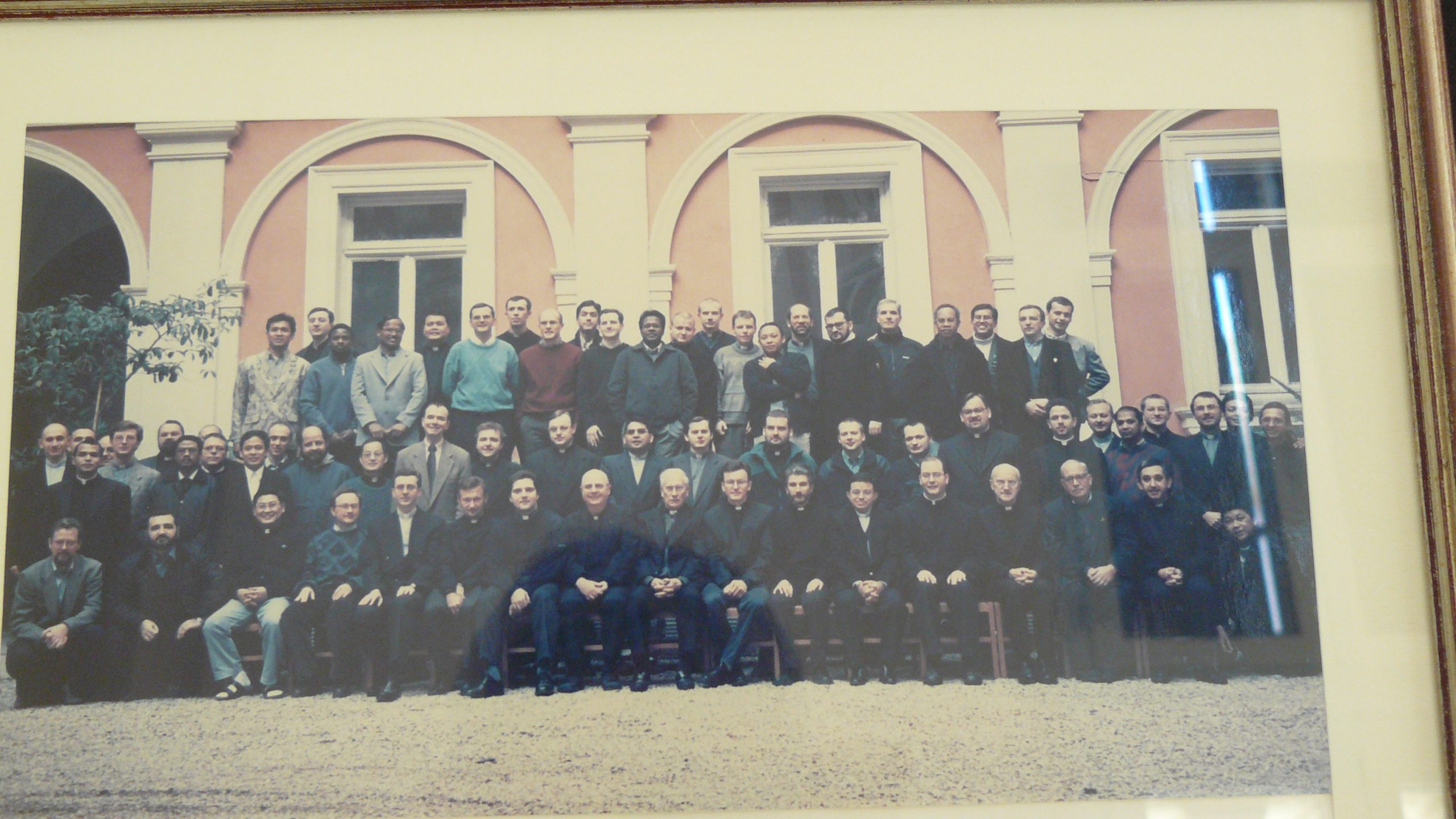
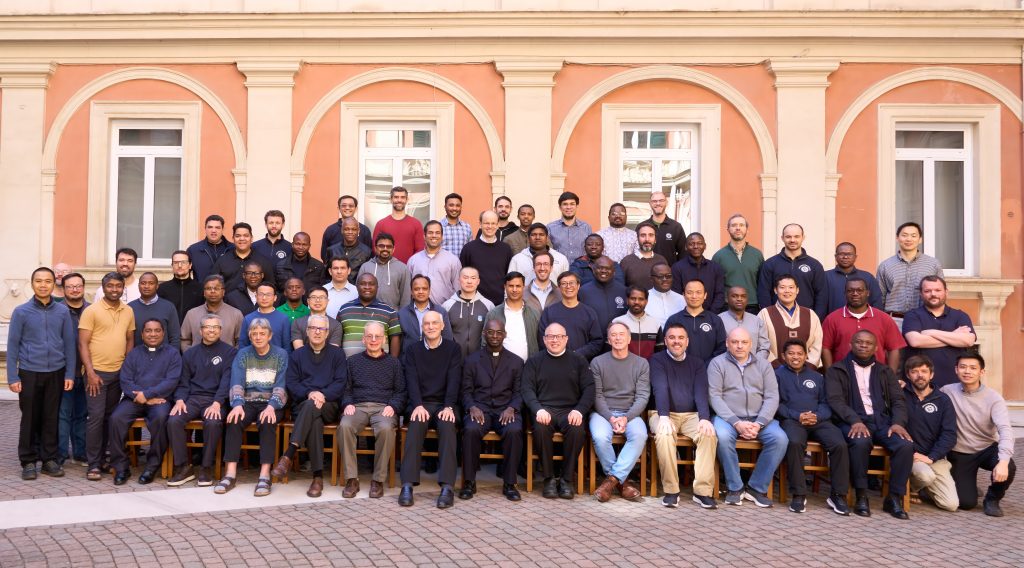
II.1970-2020
Evolution in the geographical origin
of Bellarmino community members
over the last 50 years
according to current
«Provincial Conference» designations
A : Year
B : Africa and Madagascar (JCAM)
C : Latin America (CPAL)
D : North America (JCCU)
E : East Asia (JCAP)
F : South Asia (JCSA)
G : Europe (JCEP)
H : Total
| A | B | C | D | E | F | G | H |
| 2020 | 16 | 11 | 7 | 8 | 7 | 18 | 67 |
| 2010 | 15 | 7 | 8 | 5 | 11 | 21 | 67 |
| 2000 | 10 | 13 | 7 | 7 | 6 | 42 | 85 |
| 1990 | 8 | 21 | 26 | 12 | 13 | 40 | 120 |
| 1980 | 6 | 24 | 14 | 8 | 4 | 65 | 121 |
| 1970 | 1 | 26 | 15 | 4 | 3 | 72 | 121 |
III. 1976-2021
The collaborators
1976 Mejia Saldarriaga Rodrigo Mgr (AOR) eng: From Colombia to Etiopia
1977 Taliano Antonino (EUM) ita: Tra una formazione approfondita e la missione nel campo
1980 Pietras Henryk (PME) ita: Anni felici
1982 Amani Leo (AOR) eng: Psicology and brotherhood
1985 Mattheeuws Alain (EOF) fra : Une expérience ecclésiale et de la compagnie universelle
1986 Kujur Sudhir (RAN) eng : A strong sense of “we” feeling among us
1992 Bafuidinsoni Jean-Donat Mgr (ACE) fra : Études, mission, providence
1995 Xalxo Leander (MAP): Unity in diversity
1996 Pattarumadathil Henry (KER) eng: From Kerala to Biblical Institute
1998 Kokkaravalayil Sunny Thomas (KER) eng: I was the only one studying at the Orientale
1999 Bizant Milan (SVN) ita: Compagnia universale ed amicizie profonde
2002 Kupelesa Ilunga Max. (ACE) fra : Seul en psychologie
2003 Lentiampa Adrien (ACE) fra : L’expérience de passer au Collège Bellarmin
2004 Alonso-Lasheras Diego (ESP) esp: Vida eclesial y preparación académica
2006 Vitoriano Ribeiro Elton (BRA) bra: Imponência arquitetônica e minha casa
2009 Dwi Kristanto Heribertus (IDO) eng : A unique experience
2009 Ravelokamisy Léonard (MDG) fra : Quelques années propices à Rome
2010 Modrić Alan (CRO) ita: Una compagnia internazionale per un destino ecclesiale mondiale
2012 Sáenz A. Christian (ANT) eng: Practically in the library, ideal situation
2013 Jaovary Julien (MDG) fra : Approfondissement et rénovation
2013 Nguyen Mai Kha (VIE) eng: A marvelous experience, and today
2015 Yuraszeck Krebs José Francisco (CHL) esp: Estudios y ministerios eclesiales
2015 Rukavina Tomislav (CRO) ita: Una vita spirituale significativa
2017 Espinal Cristhian (CAR) esp: Vida académica y crecimiento espiritual
2017 Peña Martinez Moisès Roberto (COL) esp: La amabilidad y «nuestro modo de proceder»
2018 Tolande Gabriel (ACE) fra : Deux anciens animaient la vie spirituelle
2019 Mireles Bueno Enrique Javier (MEX) esp: Misión en y de la compañía 2021 Ortega Silva Marcos (MEX) esp: Un colegio particular por una misión universal
IV. Vocation for Mission
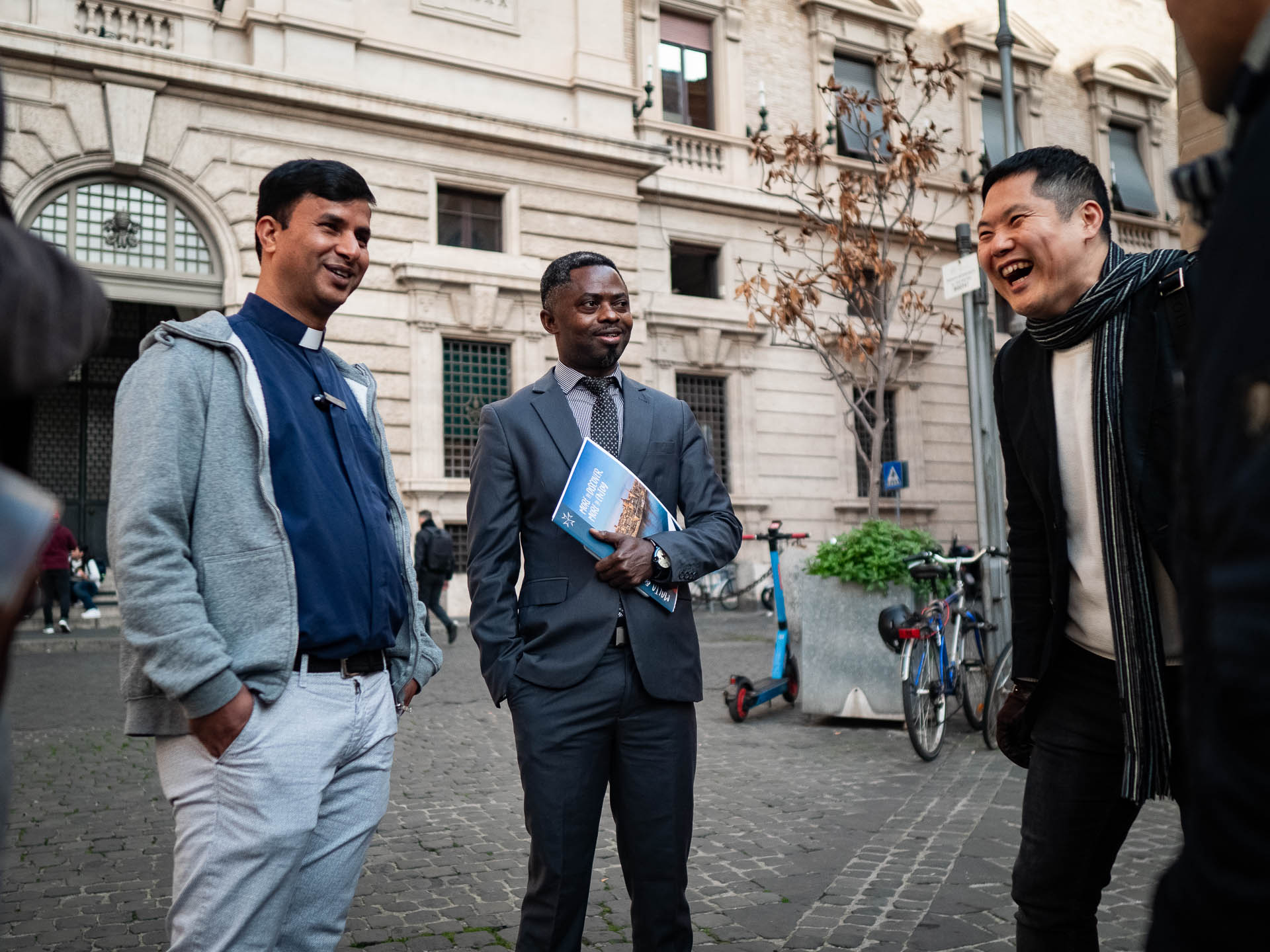
We do not consider “vocation” as an end in itself, but intrinsically linked to a specific “mission” in the world. God’s call is not only to be a religious, but to be a religious for a particular mission: to serve God in the world, to work for the good of souls, especially where the needs are greatest. “Vocation for Mission” means that the call to follow Christ in the Society of Jesus within the Church, is inseparable from an active and concrete commitment to the Kingdom of God in the world.
1. Philip Shi Yuqian, SJ
Fr. Philip Shi Yuqian, a doctoral student in canon law from the Chinese province of the Society of Jesus, recounts his experience of moving to Rome during the COVID-19 pandemic. Despite initial fears, he found solace in the community’s support, especially during his quarantine. Philip also shared his positive experience working with the tribunal of the Hong Kong diocese, where he applied his studies to handle marriage cases, enhancing his appreciation for his mission and personal value in his work.
2. Michael Rossmann, SJ
Fr. Michael Rossmann, a Jesuit from the USA, completed his doctorate in missiology with a focus on media for evangelization at the Pontifical Gregorian University. He values the international community at the Bellarmino, where all members adapt to a new culture, fostering solidarity. Rossmann appreciates Rome as the ecclesial crossroads, studying alongside diverse clergy and laypeople, and participating in papal masses that represent faithful from the Church universal. His favorite spot is the colorful rooftop terrace and its scenic landscape. He has also served as a chaplain for Loyola University Chicago’s Rome campus, celebrating mass for students and engaging in pastoral activities with them.
3. Lancy Dias, SJ
Fr. Lancy Dias, a Jesuit doctoral candidate from Karnataka, India, is nearing completion of his studies and will teach at the Gregorian University’s Institute of Psychology. He values the international community at the university and in his community, which fosters cross-cultural and interdisciplinary learning. Dias has longed to visit Chiesa del Gesu for 20 years, and cherishes its significance as a mother church and the site of the Chapel of Our Lady of the Way. He recalls two significant experiences: celebrating mass with the Pope and participating in the beatification process of Pedro Arrupe, a Jesuit he admires greatly.
4. Jose Luis Cruz Ramos, SJ
Fr. Jose Luis Cruz Ramos, a Jesuit from Honduras, is studying dogmatic theology at the Gregorian University. He emphasizes the significance of interculturality and the enriching experiences shared among students from diverse backgrounds. The Gregorian program offers a diverse range of studies, including theology, philosophy, and communication, fostering interdisciplinarity and collaboration with other pontifical institutions. Cruz highlights the importance of community spaces of the Collegio Bellarmino like the refectory and shared rituals, such as the Eucharist, as integral to the communal advancement and spiritual growth of the students in Rome.
5. Martin Rondelet, SJ
Fr. Martin Rondelet, a Belgian Jesuit, describes his experience studying biblical theology in Rome after two years of part-time work in medicine and youth ministry. He highlights a transformative course taught by three professors, one in patristics, one in modern exegesis, and a rabbi, who addressed different ways of interpreting the Bible. He also reflects on the powerful experience of praying in St. Peter’s Square during the synod, emphasizing the Church’s sense of universal unity. He also shares his appreciation for the College’s terrace in Rome, a serene place for contemplation surrounded by nature with a magnificent view.
6. Cedrick Mokonzi, SJ
Fr. Mokonzi, a Congolese Jesuit from the Central Africa Province, explains his choice of fundamental theology, which he finds suited to his philosophical and existential aspirations. He prefers to spend time in his room, a place of privacy and work. He has been impressed by the silence and hospitality of his community. A significant experience for him was the Christian Unity Week in Rome, where he discovered various Catholic rites, which greatly enriched and amazed him.