
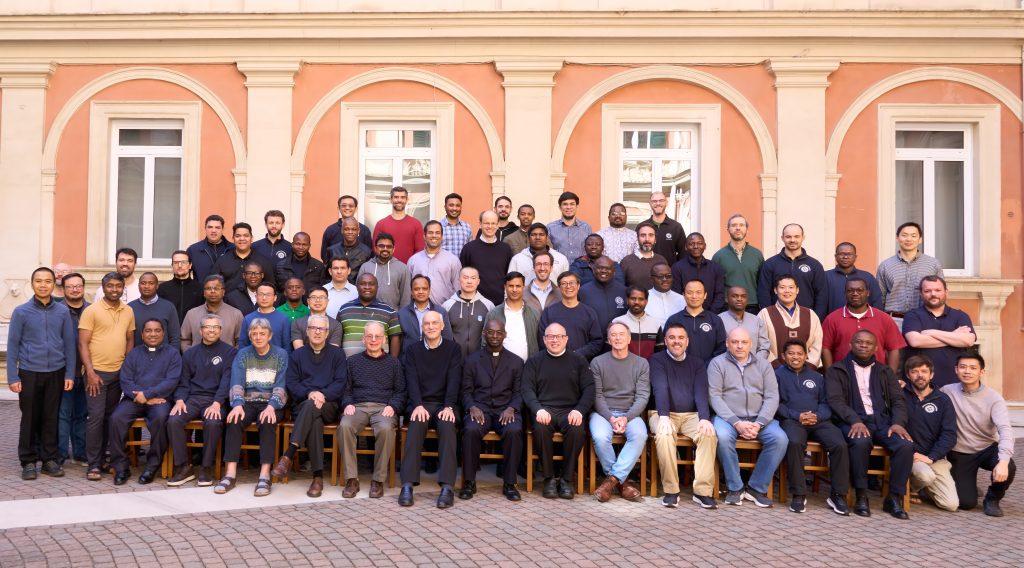
We do not consider “vocation” as an end in itself, but intrinsically linked to a specific “mission” in the world. God’s call is not only to be a religious, but to be a religious for a particular mission: to serve God in the world, to work for the good of souls, especially where the needs are greatest. “Vocation for Mission” means that the call to follow Christ in the Society of Jesus within the Church, is inseparable from an active and concrete commitment to the Kingdom of God in the world.
1. Philip Shi Yuqian, SJ
Fr. Philip Shi Yuqian, a doctoral student in canon law from the Chinese province of the Society of Jesus, recounts his experience of moving to Rome during the COVID-19 pandemic. Despite initial fears, he found solace in the community’s support, especially during his quarantine. Philip also shared his positive experience working with the tribunal of the Hong Kong diocese, where he applied his studies to handle marriage cases, enhancing his appreciation for his mission and personal value in his work.
2. Michael Rossmann, SJ
Fr. Michael Rossmann, a Jesuit from the USA, completed his doctorate in missiology with a focus on media for evangelization at the Pontifical Gregorian University. He values the international community at the Bellarmino, where all members adapt to a new culture, fostering solidarity. Rossmann appreciates Rome as the ecclesial crossroads, studying alongside diverse clergy and laypeople, and participating in papal masses that represent faithful from the Church universal. His favorite spot is the colorful rooftop terrace and its scenic landscape. He has also served as a chaplain for Loyola University Chicago’s Rome campus, celebrating mass for students and engaging in pastoral activities with them.
3. Lancy Dias, SJ
Fr. Lancy Dias, a Jesuit doctoral candidate from Karnataka, India, is nearing completion of his studies and will teach at the Gregorian University’s Institute of Psychology. He values the international community at the university and in his community, which fosters cross-cultural and interdisciplinary learning. Dias has longed to visit Chiesa del Gesu for 20 years, and cherishes its significance as a mother church and the site of the Chapel of Our Lady of the Way. He recalls two significant experiences: celebrating mass with the Pope and participating in the beatification process of Pedro Arrupe, a Jesuit he admires greatly.
4. Jose Luis Cruz Ramos, SJ
Fr. Jose Luis Cruz Ramos, a Jesuit from Honduras, is studying dogmatic theology at the Gregorian University. He emphasizes the significance of interculturality and the enriching experiences shared among students from diverse backgrounds. The Gregorian program offers a diverse range of studies, including theology, philosophy, and communication, fostering interdisciplinarity and collaboration with other pontifical institutions. Cruz highlights the importance of community spaces of the Collegio Bellarmino like the refectory and shared rituals, such as the Eucharist, as integral to the communal advancement and spiritual growth of the students in Rome.
5. Martin Rondelet, SJ
Fr. Martin Rondelet, a Belgian Jesuit, describes his experience studying biblical theology in Rome after two years of part-time work in medicine and youth ministry. He highlights a transformative course taught by three professors, one in patristics, one in modern exegesis, and a rabbi, who addressed different ways of interpreting the Bible. He also reflects on the powerful experience of praying in St. Peter’s Square during the synod, emphasizing the Church’s sense of universal unity. He also shares his appreciation for the College’s terrace in Rome, a serene place for contemplation surrounded by nature with a magnificent view.
6. Cedrick Mokonzi, SJ
Fr. Mokonzi, a Congolese Jesuit from the Central Africa Province, explains his choice of fundamental theology, which he finds suited to his philosophical and existential aspirations. He prefers to spend time in his room, a place of privacy and work. He has been impressed by the silence and hospitality of his community. A significant experience for him was the Christian Unity Week in Rome, where he discovered various Catholic rites, which greatly enriched and amazed him.


